Zarnelvioq
Slate Framework
Slate Framework
Couldn't load pickup availability
1. Problem Statement
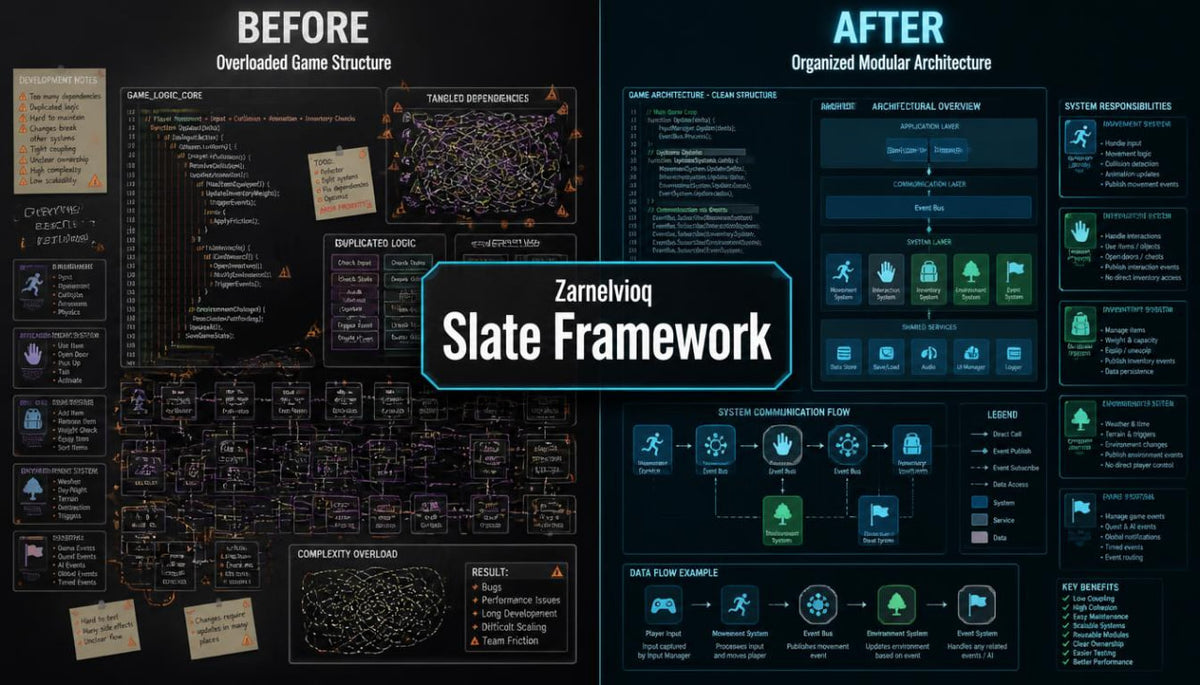
As game development projects expand beyond individual mechanics, organizing the relationships between different systems becomes an increasingly important challenge. Learners may understand how separate interactions function but encounter difficulties when combining movement, environment behavior, progression logic, and gameplay data into a unified structure. Without clear architectural planning, closely connected components can become difficult to examine, modify, or reuse during development. Changes to one part of a game may influence unrelated systems, creating additional work when evaluating interactions or introducing new mechanics. Understanding modular organization and system responsibilities provides learners with a structured approach to managing these relationships while maintaining clarity throughout the design process.
2. Solution
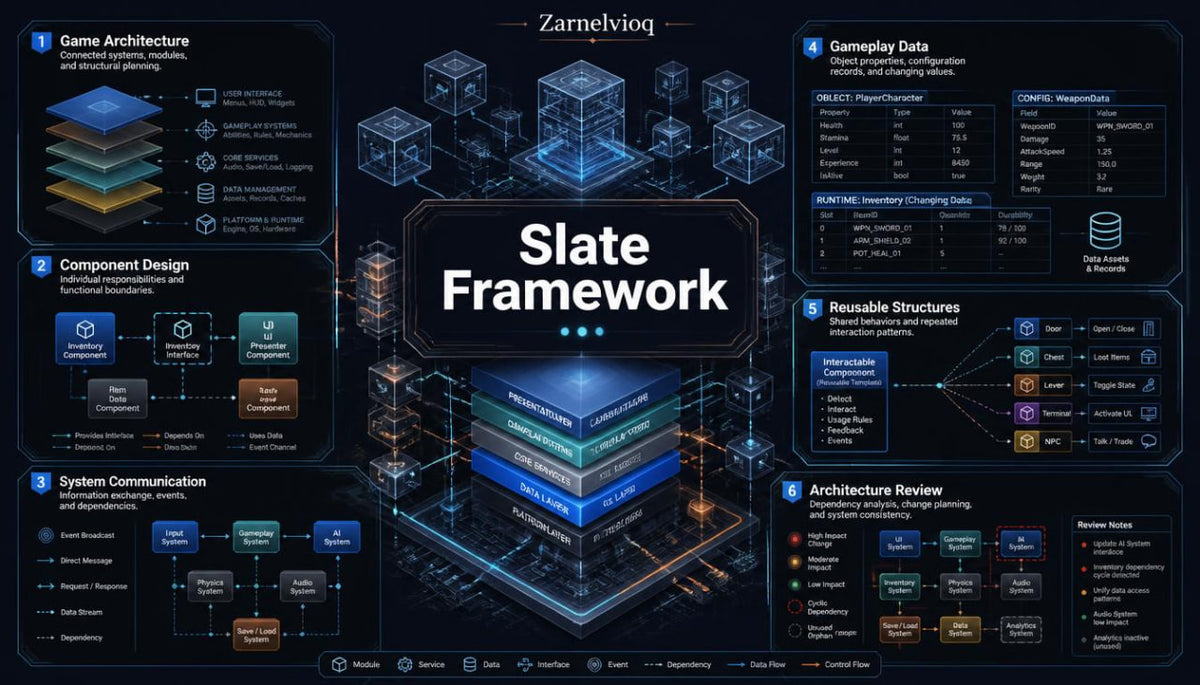
Slate Framework introduces the principles of modular game architecture through an organized sequence of theoretical explanations and practical design activities. The course examines how game systems can be divided into components with clearly described responsibilities and defined relationships. Learners explore architectural diagrams, data organization methods, component communication, and techniques for documenting system behavior. Guided exercises demonstrate how separate gameplay elements can be organized into connected structures without unnecessary dependencies. The concluding design workshop brings these concepts together in an architectural planning document for a fictional interactive game.
3. What's Inside
Slate Framework contains ten detailed learning modules dedicated to game architecture, component organization, system communication, and structured development planning.
The course connects previously studied gameplay logic with broader architectural principles used to organize interactive projects.
Learning materials include illustrated examples, guided exercises, architectural diagrams, component worksheets, and a concluding design workshop.
Module 01 — Beneath the Surface of a Game
The opening module introduces game architecture as a method of organizing gameplay components and defining their relationships.
Learners examine how movement systems, interactive objects, environmental rules, and progression structures contribute to a wider game design.
The materials explain the difference between individual mechanics and architectural structures that coordinate multiple mechanics.
Several fictional game examples illustrate how architectural decisions influence the organization of an interactive project.
Practical activity: Examine a fictional game concept and identify its primary systems, their responsibilities, and their relationships with other components.
Module 02 — Dividing Complexity Into Components
Large interactive structures can be examined through smaller components with clearly defined responsibilities.
This module introduces component-based thinking and explores how individual elements can be organized around specific tasks.
Learners examine examples involving player movement, environmental interaction, object behavior, and gameplay objectives.
The materials explain why separating unrelated responsibilities can make a design easier to understand and revise.
Participants compare different component arrangements and identify unnecessary connections between systems.
Practical activity: Create a component breakdown diagram for a small game concept containing at least six functional components.
Module 03 — Responsibilities and System Boundaries
Each component within an architectural structure should have a clearly described purpose.
This module explores system boundaries, responsibility assignment, and the relationship between closely connected mechanics.
Learners examine how unclear responsibilities may lead to repeated logic or unexpected dependencies.
The materials introduce responsibility tables as a method for documenting which component handles a particular action or condition.
Examples demonstrate how movement, interaction, progression, and environmental state can be assigned to different systems.
Practical activity: Develop a system responsibility chart identifying the purpose, inputs, outputs, and dependencies of selected gameplay components.
Module 04 — Designing Communication Between Systems
Interactive systems frequently need to exchange information about player actions, environmental conditions, and gameplay events.
This module introduces communication pathways between architectural components.
Learners examine direct interactions, event notifications, and shared information structures.
The materials explore how information travels between systems and how communication decisions influence component relationships.
Practical scenarios demonstrate how an object interaction can influence progression, environmental behavior, and player feedback.
Practical activity: Create a communication diagram illustrating how five components exchange information during a fictional gameplay sequence.
Module 05 — Organizing Gameplay Data
Game systems rely on information that describes objects, interactions, player conditions, and changing environmental states.
This module introduces structured data organization and its relationship to game architecture.
Learners explore categories of gameplay information, including object properties, interaction conditions, progression values, and state descriptions.
The materials distinguish between relatively stable configuration information and values that change during gameplay.
Participants examine how consistent data structures can support clear communication between different components.
Practical activity: Design a data organization sheet describing the information required by several connected gameplay systems.
Module 06 — Reusable Patterns in Game Design
Many interactive projects contain objects or mechanics that follow similar behavioral structures.
This module examines reusable architectural patterns and methods for describing repeated functionality.
Learners compare several fictional interaction systems and identify their shared characteristics.
The materials explain how common behaviors can be represented through structured component descriptions while preserving differences between individual objects.
Examples include interactive doors, environmental switches, collectible objects, and task-related mechanisms.
Practical activity: Develop a reusable component specification for a group of interactive objects with related behavior and different configuration values.
Module 07 — Managing Events Across Components
Events can connect independent gameplay components without requiring every system to control another directly.
This module explores the role of event organization within modular game architecture.
Learners examine event sources, listeners, communication sequences, and system responses.
The materials demonstrate how a single gameplay event may influence several components.
Participants also consider the importance of documenting event order, repeated notifications, and responses to unexpected conditions.
Practical activity: Prepare an event communication map showing how a gameplay event influences multiple independent systems.
Module 08 — Planning for Changes and Extensions
Game concepts frequently evolve as new mechanics, environments, and interaction requirements are introduced.
This module examines architectural flexibility and the role of structured documentation in evaluating changes.
Learners explore how adding a new mechanic may influence existing components and communication pathways.
The materials introduce change-impact diagrams for identifying affected systems before revising an architectural plan.
Examples compare tightly connected designs with more clearly separated component structures.
Practical activity: Extend an existing architectural diagram with a new gameplay mechanic and document the resulting system changes.
Module 09 — Reviewing Architectural Consistency
Architectural planning benefits from regular examination of component responsibilities and communication relationships.
This module introduces structured architectural review techniques.
Learners examine examples containing duplicated responsibilities, unclear dependencies, missing information pathways, and conflicting system behavior.
The materials provide review questions for evaluating architectural diagrams and component specifications.
Participants practice identifying relationships that may require clarification or restructuring.
Practical activity: Evaluate a fictional game architecture, identify organizational concerns, and prepare a written revision plan.
Module 10 — The Architecture Design Workshop
The concluding module combines all previously studied concepts into an integrated planning project.
Learners develop an architectural design document for a fictional interactive game containing multiple connected gameplay systems.
The project includes component descriptions, responsibility tables, communication diagrams, data structures, and event relationships.
Participants examine how the proposed architecture responds to changes in gameplay conditions and additional mechanics.
The workshop concludes with a structured review of system boundaries, dependencies, and documented design decisions.
Practical activity: Complete a modular game architecture document that describes the relationships between gameplay components and outlines their expected behavior within a connected interactive environment.
Additional Course Materials
Slate Framework includes supporting resources designed to accompany the learning modules and practical activities.
Game Architecture Workbook: Structured planning pages for identifying primary gameplay systems, their responsibilities, and their architectural relationships.
Component Planning Templates: Worksheets for documenting component purposes, required information, supported interactions, and related dependencies.
System Responsibility Matrix: A reference table for assigning gameplay behaviors to specific architectural components.
Communication Flow Diagrams: Guided diagram templates for mapping information exchange between connected gameplay systems.
Gameplay Data Planning Sheets: Resources for organizing configuration information, changing values, object properties, and state descriptions.
Reusable Component Worksheets: Planning activities for examining repeated interaction patterns and documenting shared behavioral structures.
Event Mapping Templates: Diagram resources for identifying event sources, communication pathways, and corresponding system responses.
Architecture Review Checklist: Structured questions for examining dependencies, component boundaries, communication consistency, and architectural organization.
Change-Impact Worksheet: A planning resource for documenting how new mechanics or revised behaviors influence existing components.
Final Architecture Project Template: A structured document that brings together the course activities into one integrated architectural design.
These resources encourage learners to approach architectural planning through careful observation, organized documentation, and practical experimentation.
4. Who Is This For?
Slate Framework is intended for learners interested in understanding how multiple game systems can be organized within a coherent architectural structure.
The course may be suitable for individuals who have already explored gameplay mechanics, interactive logic, environmental behavior, and introductory systems design.
It is particularly relevant to learners who want to examine modular design, component responsibilities, event communication, and the organization of gameplay information.
Participants who enjoy analyzing complex structures, creating diagrams, or documenting technical relationships may find the activities relevant to their learning interests.
The materials can also support independent learners who are developing personal game concepts and want to establish a clearer organizational framework before implementation.
Familiarity with conditional logic, game states, and interactive system relationships is recommended.
Previous practical programming experience may provide additional context, although the course activities primarily emphasize architectural planning and conceptual understanding.
The course does not require participants to create a completed playable game.
5. What You'll Learn
Through Slate Framework, learners can explore the following skills and areas of knowledge:
-
Identify the primary architectural components of an interactive game.
-
Explain relationships between gameplay mechanics and architectural systems.
-
Divide complex gameplay structures into smaller functional components.
-
Define clear responsibilities for individual systems.
-
Document system boundaries and component dependencies.
-
Create architectural diagrams for connected game mechanics.
-
Describe communication pathways between separate components.
-
Organize gameplay data into structured categories.
-
Distinguish between configuration information and changing gameplay values.
-
Identify shared interaction patterns across different game objects.
-
Develop reusable component specifications.
-
Document event communication between independent systems.
-
Examine how architectural changes influence existing gameplay components.
-
Create change-impact diagrams for new mechanics.
-
Recognize duplicated responsibilities and unclear system relationships.
-
Apply structured review questions to architectural plans.
-
Organize component descriptions into a coherent design document.
-
Develop an integrated architectural blueprint for a fictional game.
-
Evaluate architectural consistency through guided planning exercises.
-
Connect modular design principles with broader game development processes.
The learning activities focus on analytical thinking, structured documentation, and the organization of interconnected gameplay systems.
6. 30-Day Refund Information
Transparent Purchase Conditions and Course Support
Slate Framework is a digital educational course containing structured learning modules, architectural planning activities, and supporting study resources.
Customers may submit refund requests within 30 days of purchase, subject to the conditions described in the Zarnelvioq Refund Policy and applicable consumer protection requirements.
- 📦 Digital file available after purchase
- 🔄 Long-term availability
- 🛡️ Secure checkout
- 🔄 Content updated in 2026
Self-paced learning overview
What topics are covered in Zarnelvioq courses?
What topics are covered in Zarnelvioq courses?
Zarnelvioq courses explore different areas of game development, including gameplay mechanics, interactive environments, design structures, player interaction, and project planning. Each course focuses on a defined set of topics, combining theoretical explanations with practical activities that encourage learners to examine how interactive experiences are created.
Do I need previous game development experience?
Do I need previous game development experience?
The recommended background depends on the selected course. Introductory materials explain foundational concepts, while later courses examine more detailed design processes and technical structures. Each course description outlines its learning focus so participants can select materials that correspond to their current knowledge.
How are the learning materials organized?
How are the learning materials organized?
The courses are arranged into topic-based modules with explanations, examples, and practical exercises. The learning sequence moves from individual concepts toward activities that connect related ideas. Participants can review the materials at their own pace and revisit individual sections while developing their understanding.
Share