Zarnelvioq
Neon Series
Neon Series
Couldn't load pickup availability
1. Problem Statement
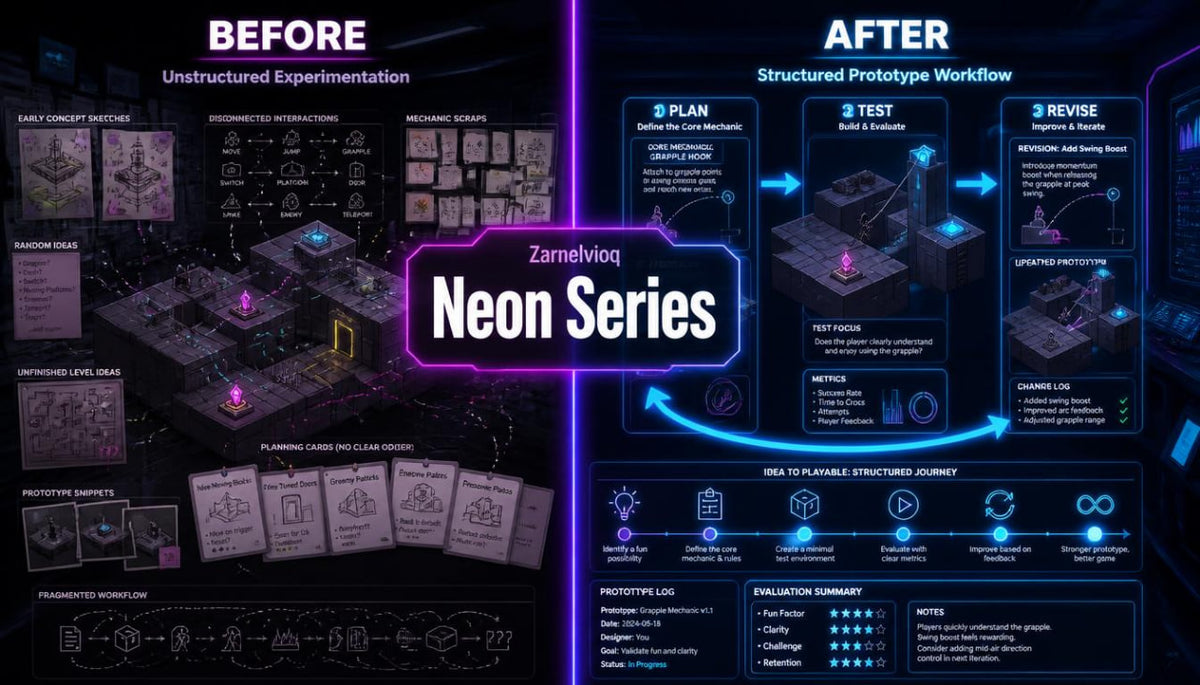
Developing a game concept beyond its initial design stage requires an understanding of how proposed mechanics behave when combined into an interactive experience. Learners may create detailed gameplay documents and architectural diagrams but encounter difficulties when translating those plans into testable prototypes. Unclear interaction sequences, unexpected system behavior, and disconnected mechanics can become apparent only when design ideas are examined through practical scenarios. Without an organized prototyping process, it can be challenging to determine which elements require revision and how individual changes influence the wider experience. Studying iterative development provides learners with a structured approach to experimenting with gameplay concepts, documenting observations, and refining interactive designs.
2. Solution
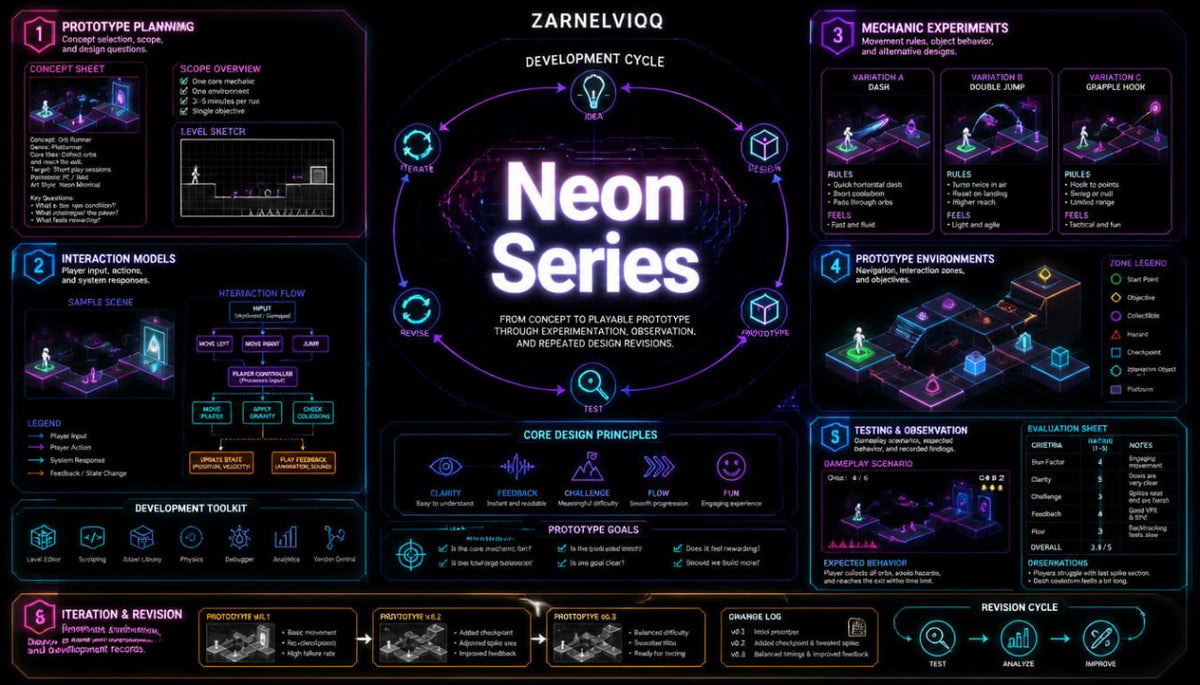
Neon Series introduces a practical approach to gameplay prototyping and iterative project development through connected learning activities. The course examines how initial concepts can be represented through simplified prototypes, interaction diagrams, and structured gameplay scenarios. Learners explore methods for testing individual mechanics, organizing development tasks, and documenting changes throughout repeated design cycles. Guided exercises demonstrate how observation and evaluation can inform decisions about movement, interaction rules, feedback, and gameplay progression. The concluding workshop combines these methods into an integrated prototype planning project supported by testing documents and revision records.
3. What's Inside
Neon Series contains ten detailed learning modules focused on prototyping methods, gameplay experimentation, interaction testing, project organization, and iterative design.
The course connects earlier knowledge of gameplay mechanics, environment planning, interactive logic, and player experience with practical prototyping activities.
Each module includes theoretical explanations, guided examples, and exercises designed to examine how game concepts evolve through structured experimentation.
Module 01 — The First Shape of an Interactive Idea
This module introduces prototyping as a method for exploring gameplay concepts before committing to a detailed implementation.
Learners examine the difference between an early design concept, a simplified prototype, and a more developed interactive experience.
The materials explain how prototypes can isolate particular gameplay questions, allowing individual mechanics to be examined separately.
Examples include movement sketches, interaction sequences, and simplified environmental scenarios.
Practical activity: Prepare a prototype concept sheet describing a central mechanic, the intended interaction, and the questions the prototype should explore.
Module 02 — Choosing What to Prototype
Not every element of a game concept needs to be examined at the same stage.
This module introduces prototype scope, design priorities, and methods for identifying the interactions that require investigation.
Learners explore how a prototype can concentrate on one gameplay mechanic rather than an entire game structure.
The materials examine how unnecessary detail can distract from the question being studied.
Practical activity: Develop a prototype scope document identifying the central interaction, supporting elements, expected behavior, and features excluded from the initial experiment.
Module 03 — Building Interaction Models
Interactive prototypes require clear descriptions of player actions and corresponding system responses.
This module examines how gameplay interactions can be represented through simple models, diagrams, and sequential scenarios.
Learners study movement behavior, object activation, environmental responses, and changes in game state.
The materials introduce methods for representing interactions using sketches, flowcharts, and written action sequences.
Practical activity: Create an interaction prototype showing how player input produces changes within a fictional environment.
Module 04 — Experimenting With Gameplay Mechanics
Gameplay mechanics may behave differently when examined within a wider interactive structure.
This module explores controlled gameplay experiments and methods for comparing alternative design approaches.
Learners examine how changes to movement conditions, interaction timing, or objective requirements can influence gameplay behavior.
The materials demonstrate how to document the conditions of an experiment and compare the resulting observations.
Practical activity: Develop three variations of a gameplay mechanic and record the design differences, intended behavior, and observations for each variation.
Module 05 — Connecting Mechanics Into Playable Sequences
Individual mechanics become part of a broader experience when their interactions are organized into connected sequences.
This module examines how movement, objects, environmental conditions, and objectives contribute to gameplay progression.
Learners explore methods for combining independent interactions without introducing unnecessary complexity.
The materials introduce sequence diagrams that describe how gameplay moves between different activities.
Practical activity: Design a connected gameplay sequence containing movement, object interaction, changing conditions, and a defined objective.
Module 06 — Designing Prototype Environments
A prototype environment provides a setting in which gameplay interactions can be examined.
This module introduces simplified spatial planning, temporary visual elements, interaction zones, and navigational boundaries.
Learners examine why early environments often emphasize functional clarity rather than decorative detail.
Examples demonstrate how basic geometric representations can communicate pathways, obstacles, and interactive objects.
Practical activity: Create a prototype environment plan containing a player starting location, navigation routes, interactive objects, and a gameplay objective.
Module 07 — Observing Behavior and Recording Findings
Prototype evaluation involves comparing intended gameplay behavior with observed interactions.
This module introduces structured testing scenarios, observation records, and methods for documenting unexpected responses.
Learners examine how unclear instructions, inconsistent rules, and confusing environmental arrangements can be identified during evaluation.
The materials distinguish between factual observations, possible explanations, and proposed design revisions.
Practical activity: Prepare a prototype evaluation report containing test scenarios, observed behavior, identified concerns, and suggested modifications.
Module 08 — Revising Through Iterative Design
Iterative development involves examining a design, making adjustments, and evaluating the revised version.
This module explores revision cycles, change tracking, and methods for comparing different prototype versions.
Learners examine how a modification to one interaction may influence related mechanics or environmental conditions.
The materials introduce revision logs and comparison worksheets for documenting design decisions.
Practical activity: Complete two documented revision cycles for a fictional gameplay prototype, explaining the reasoning behind each adjustment.
Module 09 — Organizing the Development Process
Prototyping becomes more manageable when activities, resources, and decisions are documented through an organized workflow.
This module introduces development milestones, task grouping, prototype documentation, and methods for reviewing project progress.
Learners explore how larger activities can be divided into smaller design tasks with clearly described objectives.
The materials also examine the relationship between planning documents, design revisions, and evaluation records.
Practical activity: Create a prototype development plan containing design tasks, review stages, documentation requirements, and proposed evaluation activities.
Module 10 — The Neon Prototype Workshop
The concluding module brings together the concepts studied throughout Neon Series.
Learners organize a fictional game concept into a detailed prototype project supported by interaction models, environment sketches, gameplay sequences, and testing documentation.
The workshop examines how individual mechanics can be represented, evaluated, and revised within a connected design structure.
Participants prepare a written development record that explains their decisions and identifies areas for further experimentation.
Practical activity: Complete an interactive prototype design portfolio containing a concept specification, gameplay diagrams, environment plan, evaluation notes, and documented revision history.
Additional Course Materials
Neon Series includes supporting resources corresponding to the practical activities throughout the modules.
Prototype Planning Workbook: Guided pages for documenting prototype objectives, gameplay questions, and design boundaries.
Interaction Modeling Templates: Resources for representing player actions, system responses, and connected gameplay events.
Gameplay Experiment Sheets: Structured tables for comparing alternative mechanic designs and recording observations.
Prototype Environment Planner: Diagram templates for organizing simplified interactive spaces and testing locations.
Gameplay Sequence Maps: Worksheets for documenting connected interactions, objective conditions, and progression stages.
Evaluation Report Templates: Planning resources for recording test scenarios, expected behavior, and observed responses.
Iteration Tracking Journal: A structured record for documenting design changes and comparing different prototype versions.
Development Task Planner: Worksheets for organizing activities, project milestones, and review stages.
Final Prototype Portfolio: A concluding project document bringing together design specifications, interaction diagrams, testing records, and revision notes.
The resources are intended to support independent experimentation, organized documentation, and practical exploration of gameplay prototyping.
4. Who Is This For?
Neon Series is intended for learners who want to explore the practical development of gameplay concepts through structured prototyping activities.
The course may be suitable for individuals familiar with game mechanics, interactive logic, environment planning, and introductory player experience design.
It is particularly relevant to learners interested in testing gameplay ideas, comparing mechanic variations, examining interaction behavior, and organizing development activities.
Participants who enjoy practical experimentation and documenting how design concepts change through repeated evaluation may find the course relevant to their interests.
The materials also support independent learners developing personal game concepts who want to study prototyping methods before approaching larger interactive projects.
Familiarity with gameplay systems and design documentation is recommended.
The course emphasizes prototype planning, interaction modeling, evaluation, and iteration rather than requiring a fully developed digital game.
5. What You'll Learn
Through Neon Series, learners can explore the following skills and areas of knowledge:
-
Explain the role of prototyping within game development.
-
Distinguish between conceptual designs and testable interaction models.
-
Define the purpose and scope of a gameplay prototype.
-
Identify mechanics that require practical examination.
-
Create prototype concept specifications.
-
Develop simplified interaction models.
-
Document player actions and system responses.
-
Compare alternative gameplay mechanic designs.
-
Organize separate mechanics into connected gameplay sequences.
-
Plan simplified environments for interaction testing.
-
Define test scenarios and expected gameplay behavior.
-
Record observations from prototype evaluation activities.
-
Identify inconsistencies within gameplay interactions.
-
Prepare structured design revision notes.
-
Compare different prototype versions.
-
Organize development tasks into documented stages.
-
Connect gameplay evaluation with iterative design decisions.
-
Create development records for an interactive concept.
-
Develop an integrated prototype design portfolio.
-
Apply structured experimentation to future game development studies.
The learning activities emphasize practical exploration, critical observation, and thoughtful revision of interactive design concepts.
6. 30-Day Refund Information
Clear Purchase Terms and Learning Support
Neon Series is a digital educational course containing structured learning modules, gameplay prototyping activities, design worksheets, and supporting study resources.
Customers may submit refund requests within 30 days of purchase, subject to the conditions described in the Zarnelvioq Refund Policy and applicable consumer protection requirements.
- 📦 Digital file available after purchase
- 🔄 Long-term availability
- 🛡️ Secure checkout
- 🔄 Content updated in 2026
Self-paced learning overview
What topics are covered in Zarnelvioq courses?
What topics are covered in Zarnelvioq courses?
Zarnelvioq courses explore different areas of game development, including gameplay mechanics, interactive environments, design structures, player interaction, and project planning. Each course focuses on a defined set of topics, combining theoretical explanations with practical activities that encourage learners to examine how interactive experiences are created.
Do I need previous game development experience?
Do I need previous game development experience?
The recommended background depends on the selected course. Introductory materials explain foundational concepts, while later courses examine more detailed design processes and technical structures. Each course description outlines its learning focus so participants can select materials that correspond to their current knowledge.
How are the learning materials organized?
How are the learning materials organized?
The courses are arranged into topic-based modules with explanations, examples, and practical exercises. The learning sequence moves from individual concepts toward activities that connect related ideas. Participants can review the materials at their own pace and revisit individual sections while developing their understanding.
Share