Zarnelvioq
Luma Archive
Luma Archive
Couldn't load pickup availability
1. Problem Statement
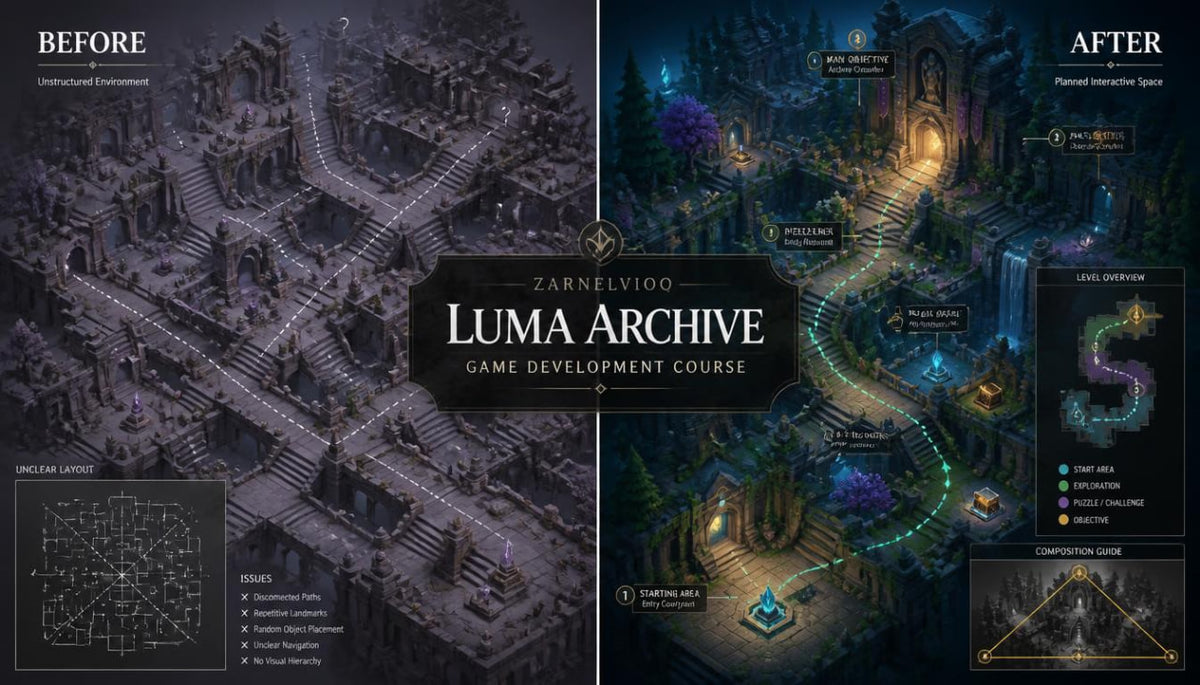
Designing a game environment involves understanding how visual elements, spatial arrangements, interactive objects, and navigation systems work together. Learners may have interesting ideas for digital worlds but find it difficult to organize those ideas into environments that support clear player movement and meaningful interaction. Without an understanding of spatial composition, environments can become visually confusing, difficult to navigate, or disconnected from their intended gameplay objectives. Additional challenges arise when attempting to balance environmental detail with functional design requirements such as pathways, boundaries, landmarks, and interactive areas. A structured approach to environment planning can help learners develop coherent spaces while understanding the relationship between visual design and gameplay functionality.
2. Solution
Luma Archive introduces a detailed learning pathway dedicated to environment design, spatial organization, and interactive world planning. The course examines how environments are constructed through layouts, visual hierarchy, navigational structures, and carefully arranged interactive elements. Learners explore different environmental approaches while studying how space can communicate direction, atmosphere, and gameplay information. Guided activities provide opportunities to sketch environments, analyze spatial relationships, and organize design decisions into structured documentation. By connecting visual composition with practical gameplay considerations, the course helps participants develop a clearer understanding of how interactive environments are planned.
3. What's Inside
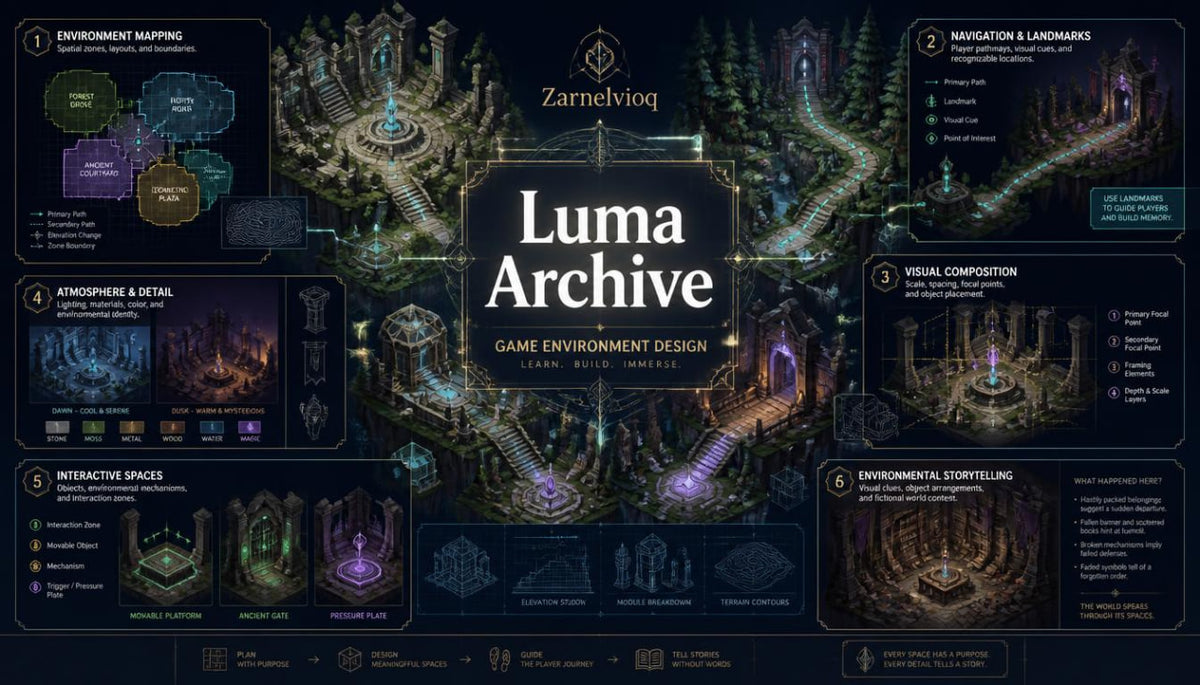
Luma Archive contains nine interconnected learning modules exploring environmental structure, world composition, navigation, visual storytelling, and spatial interaction.
The materials combine conceptual explanations with planning exercises, illustrated examples, environment analysis activities, and design worksheets.
Each module focuses on a different aspect of environment development, gradually introducing more detailed relationships between spatial structure and gameplay.
Module 01 — Reading the Language of Virtual Spaces
The opening module explores the fundamental characteristics of interactive environments.
Learners examine how digital spaces communicate information through shapes, pathways, boundaries, objects, and visual arrangements.
The materials introduce the distinction between decorative environmental elements and structures that directly influence gameplay.
Participants analyze fictional environments to identify their primary functions and the design decisions behind their layouts.
Practical activity: Create an environment observation sheet identifying navigation areas, interactive objects, visual landmarks, and gameplay boundaries.
Module 02 — Mapping the World Before Building It
A structured environment begins with an understanding of its spatial organization.
This module introduces layout planning, top-down sketches, spatial zones, and environmental boundaries.
Learners examine how different arrangements influence movement and the relationship between locations.
The materials also discuss the role of scale, spacing, and proportions when organizing playable areas.
Participants compare compact environments with larger interconnected spaces and evaluate how their structures influence navigation.
Practical activity: Develop a top-down environment map containing three connected areas, multiple pathways, and defined interaction points.
Module 03 — Pathways, Landmarks, and Player Direction
Navigation plays an important role in how players understand and explore an environment.
This module examines pathways, recognizable landmarks, environmental cues, and directional composition.
Learners explore how visual elements can communicate possible routes without requiring lengthy written instructions.
Examples demonstrate how object placement, environmental contrast, and architectural arrangements influence player attention.
The module also examines common navigation challenges, including unclear routes and visually similar locations.
Practical activity: Design a navigation plan using landmarks and environmental cues to connect several locations within a fictional level.
Module 04 — Composing Scenes With Intention
Visual composition influences how players interpret the structure and atmosphere of a digital environment.
This module introduces visual hierarchy, object grouping, environmental balance, and focal areas.
Learners examine how differences in size, shape, spacing, and arrangement can establish relationships between environmental elements.
The materials explain how important gameplay objects can be incorporated into a coherent visual composition.
Participants compare alternative layouts and describe how different arrangements influence attention and movement.
Practical activity: Create two versions of an environment composition and document the visual differences between them.
Module 05 — Atmosphere Through Environmental Details
Digital environments communicate atmosphere through visual relationships and carefully selected design elements.
This module explores environmental identity, lighting concepts, material appearance, color relationships, and decorative composition.
Learners examine how atmosphere can support the intended character of a location while remaining consistent with its gameplay function.
The materials introduce environmental themes such as abandoned structures, natural landscapes, enclosed chambers, and fictional settlements.
Participants also explore the difference between visual details that provide useful information and elements that serve a decorative purpose.
Practical activity: Prepare an environmental mood sheet describing a fictional location through visual references, color notes, material descriptions, and atmosphere-related details.
Module 06 — Building Spaces Around Interaction
Interactive environments require more than visual organization.
This module examines how spatial design connects with player actions, gameplay objectives, and changing environmental conditions.
Learners explore interaction zones, object placement, navigational restrictions, and environmental mechanisms.
Examples demonstrate how objects can serve multiple purposes, including guiding movement, communicating information, or supporting gameplay activities.
The materials introduce methods for documenting where interactions occur and how they influence surrounding spaces.
Practical activity: Create an interaction map identifying objects, player actions, environmental responses, and the locations where these interactions take place.
Module 07 — Environmental Storytelling Without Dialogue
A carefully arranged environment can communicate information about its fictional world through visible details.
This module introduces environmental storytelling as a design approach that uses locations, objects, and spatial relationships to suggest context.
Learners examine how architectural features, object arrangements, and changes in environmental condition can suggest previous events.
Examples include abandoned workspaces, damaged structures, hidden passages, and locations containing traces of fictional activity.
Participants explore how environmental clues can invite observation without requiring explicit narrative explanations.
Practical activity: Design a small environment that communicates a fictional event through object placement and visual details.
Module 08 — Evaluating Spatial Clarity
Environment design requires consideration of how players might interpret and navigate a planned space.
This module introduces introductory environment review techniques and structured observation questions.
Learners examine route clarity, visual consistency, interaction placement, and the relationship between environmental objectives and navigation.
The materials discuss how confusing layouts can be identified through hypothetical walkthroughs and diagram-based reviews.
Participants consider how revisions to object placement, pathways, and landmarks may influence the wider experience.
Practical activity: Evaluate an existing environment sketch and propose changes to improve its spatial organization and communication.
Module 09 — The Environment Archive Workshop
The concluding module brings together the environmental design concepts explored throughout the course.
Learners develop a detailed planning document for a fictional interactive environment.
The project involves defining an environmental theme, organizing spatial zones, documenting navigation routes, and identifying interactive elements.
Participants prepare supporting diagrams, written explanations, and visual planning notes.
The workshop also includes an environment review activity in which learners examine their design decisions and document areas for further exploration.
Practical activity: Complete an environment design archive containing a layout map, navigation plan, composition notes, interaction diagram, and environmental storytelling outline.
Additional Learning Materials
Luma Archive includes a collection of supporting resources designed around the practical activities.
Environment Mapping Workbook: Structured planning pages for organizing spatial zones, pathways, boundaries, and interactive areas.
Visual Composition Worksheets: Activities for examining focal points, object grouping, scale, and environmental hierarchy.
Navigation Planning Templates: Diagram resources for mapping player movement, landmarks, and environmental routes.
Environmental Atmosphere Journal: Guided pages for documenting visual themes, material ideas, color relationships, and decorative details.
Interaction Placement Guide: A reference resource for describing interactive objects and their relationship to surrounding spaces.
Environmental Storytelling Cards: Creative prompts for exploring how objects and locations can communicate fictional events.
Spatial Review Checklist: Questions for evaluating navigation clarity, environmental consistency, and the organization of playable areas.
Final Design Archive Template: A structured document for combining the course activities into one environmental planning project.
The resources encourage learners to explore ideas independently, revisit individual concepts, and document changes throughout their design activities.
4. Who Is This For?
Luma Archive is intended for learners interested in the creative and structural processes behind interactive game environments.
The course may be suitable for individuals who have already explored foundational game development concepts and want to examine spatial design in greater detail.
It is particularly relevant to learners interested in level design, digital world planning, visual composition, and environmental storytelling.
Creative individuals who enjoy sketching fictional locations, developing spatial concepts, or analyzing interactive environments may also find the activities relevant to their interests.
The materials can support learners who prefer working with diagrams, written planning documents, and visual design exercises.
Previous experience with environment construction is not required, although familiarity with introductory game design principles may be helpful.
The course focuses on conceptual development and spatial planning rather than requiring participants to construct a completed playable environment.
5. What You'll Learn
Luma Archive provides opportunities to explore the following knowledge areas and practical design activities:
-
Identify the primary components of an interactive game environment.
-
Explain how spatial structure influences player navigation.
-
Develop top-down layout maps for fictional game locations.
-
Organize environments into connected spatial zones.
-
Plan pathways, boundaries, and recognizable landmarks.
-
Examine the relationship between visual composition and player attention.
-
Apply introductory principles of scale, spacing, and object arrangement.
-
Describe environmental atmosphere through visual design notes.
-
Identify decorative and functional environmental elements.
-
Plan interactive object placement within defined locations.
-
Develop environmental interaction maps.
-
Explore storytelling through spatial arrangements and visual clues.
-
Evaluate route clarity using structured observation questions.
-
Document environmental design revisions.
-
Prepare an organized environment planning archive.
-
Connect visual design concepts with gameplay requirements.
These activities encourage thoughtful experimentation, structured documentation, and continued exploration of interactive environment design.
6. 30-Day Refund Information
Clear Purchase Terms and Customer Support
Luma Archive is a digital educational course containing structured modules, environment planning activities, and supporting learning materials.
Customers may submit a refund request within 30 days of purchase. Requests are reviewed in accordance with the Zarnelvioq Refund Policy and applicable consumer protection requirements.
Before purchasing, learners are encouraged to review the course contents, delivery information, and published refund conditions.
- 📦 Digital file available after purchase
- 🔄 Long-term availability
- 🛡️ Secure checkout
- 🔄 Content updated in 2026
Self-paced learning overview
What topics are covered in Zarnelvioq courses?
What topics are covered in Zarnelvioq courses?
Zarnelvioq courses explore different areas of game development, including gameplay mechanics, interactive environments, design structures, player interaction, and project planning. Each course focuses on a defined set of topics, combining theoretical explanations with practical activities that encourage learners to examine how interactive experiences are created.
Do I need previous game development experience?
Do I need previous game development experience?
The recommended background depends on the selected course. Introductory materials explain foundational concepts, while later courses examine more detailed design processes and technical structures. Each course description outlines its learning focus so participants can select materials that correspond to their current knowledge.
How are the learning materials organized?
How are the learning materials organized?
The courses are arranged into topic-based modules with explanations, examples, and practical exercises. The learning sequence moves from individual concepts toward activities that connect related ideas. Participants can review the materials at their own pace and revisit individual sections while developing their understanding.
Share