Zarnelvioq
Free Capsule
Free Capsule
Couldn't load pickup availability
1. Problem Statement
Game development brings together creative thinking, logical structures, visual communication, and interactive behavior, which can make the subject difficult to approach without a clear starting point. Beginners often encounter unfamiliar terminology and disconnected explanations before understanding how individual game elements relate to one another. Concepts such as player movement, environmental design, objectives, feedback, and gameplay rules may initially appear to be separate disciplines. Without an organized introduction, it can be challenging to understand how these components interact within a single playable experience. A foundational learning framework can help learners examine these relationships before moving toward more detailed development activities.
2. Solution
Free Capsule introduces game development through a structured sequence of introductory topics that connect creative decisions with interactive systems. The course begins by examining what defines a game and how player actions influence the surrounding environment. Learners then explore foundational design concepts through explanations, illustrated scenarios, and small planning exercises. Each module introduces a specific area of development before connecting it to ideas presented in earlier sections. The learning activities encourage observation, experimentation, and reflection while establishing a foundation for continued study.
3. What's Inside
Free Capsule contains seven introductory learning modules, accompanied by guided activities, design worksheets, and reflection prompts. The materials focus on understanding how game concepts develop from initial ideas into organized interactive experiences.
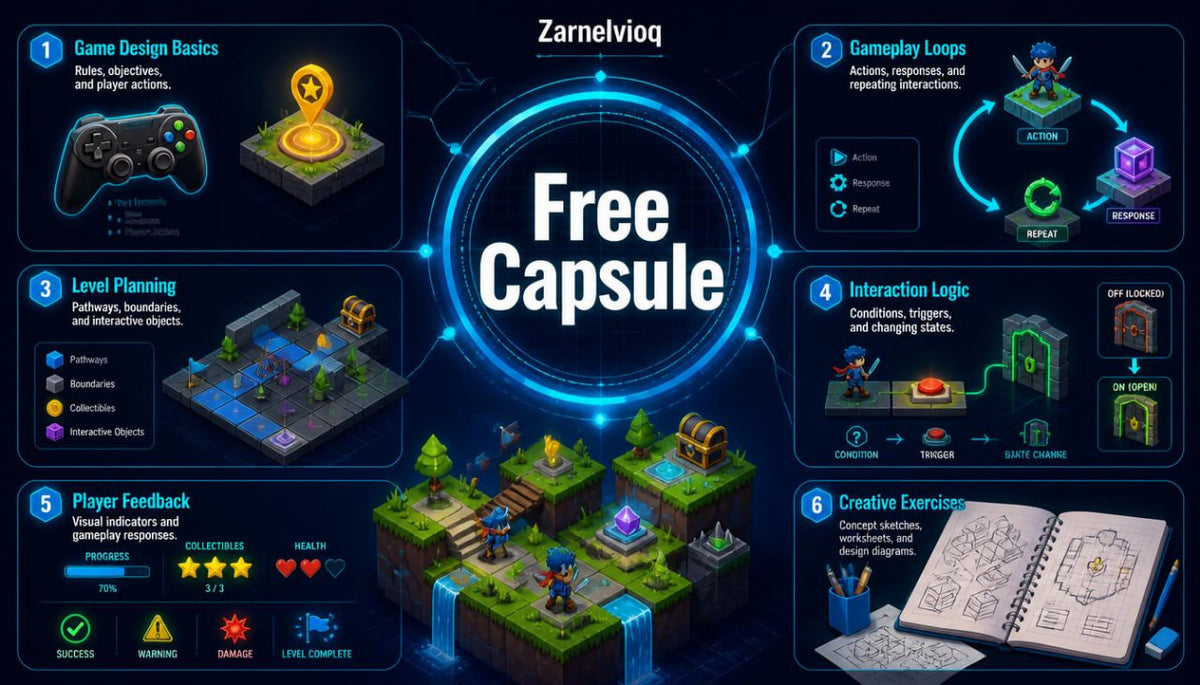
Module 01 — Where Play Begins
The opening module introduces the basic components that distinguish interactive games from other digital experiences.
Learners explore the relationship between player actions, objectives, obstacles, rules, and feedback. The material explains how these elements work together to create a recognizable gameplay structure.
Examples examine simple activities such as navigating an environment, collecting objects, completing tasks, and responding to changing conditions.
A guided exercise invites learners to describe a small game concept using a defined objective, three player actions, and a set of basic rules.
The module concludes with a reflection activity examining how changing one rule can influence the wider gameplay experience.
Module 02 — The Anatomy of a Game Loop
This module examines the recurring actions that form the foundation of gameplay.
Learners study how a game loop connects player decisions, system responses, feedback, and subsequent actions. The material introduces familiar interaction patterns through simple fictional scenarios.
A sample activity follows a character collecting objects while navigating environmental obstacles. Learners identify the actions that repeat, the conditions that change, and the information communicated to the player.
The accompanying worksheet guides participants through outlining a basic gameplay loop and describing how its individual steps relate to one another.
Module 03 — Spaces That Tell a Story
Game environments influence movement, exploration, decision-making, and the information available to players.
This module introduces introductory level design concepts, including spatial layout, boundaries, pathways, landmarks, and interactive objects.
Learners examine how the arrangement of environmental elements can guide player attention without relying entirely on written instructions.
A practical activity involves sketching a compact playable environment containing an entry point, an objective, two pathways, and several interactive elements.
Participants then describe how the environment communicates its intended direction and how alternative arrangements might change the experience.
Module 04 — Actions, Rules, and Responses
Interactive experiences depend on defined relationships between player input and system behavior.
This module introduces the logic behind actions such as moving, selecting objects, activating mechanisms, and changing environmental conditions.
Learners explore the idea of game states and examine how simple conditions influence what happens during play.
An introductory decision diagram illustrates how an interaction can produce different responses depending on the current situation.
The practical exercise asks learners to describe a small interaction involving an object, a condition, and a resulting change. The objective is to explain interactive logic clearly without requiring previous programming knowledge.
Module 05 — Feedback That Speaks Without Words
Players need information about the consequences of their actions to understand what is happening within a game.
This module introduces visual indicators, environmental changes, movement responses, and other methods of communicating gameplay information.
Examples examine how a changing object appearance, an updated counter, or a modified environment can indicate progress or communicate a change in state.
Learners review several fictional interactions and identify which information should be communicated to the player.
The practical worksheet encourages participants to design three feedback responses for a small interactive scenario and explain the purpose of each response.
Module 06 — From Concept to Playable Structure
This module connects the concepts introduced throughout the course into a small design planning activity.
Learners organize a fictional game idea around a central objective, a defined environment, basic player actions, and a collection of interactive rules.
The materials explain how a concise design outline can document the relationships between different components.
Participants work with a planning template that covers the core gameplay loop, environment layout, interaction conditions, and intended player feedback.
The activity emphasizes describing and organizing a concept rather than producing a completed digital game.
Module 07 — Observe, Evaluate, Refine
The final module introduces the role of observation and iteration in the development process.
Learners examine why a game concept may behave differently from its original design and how structured feedback can inform later revisions.
The material discusses introductory testing questions, including whether objectives are understandable, interactions are consistent, and gameplay information is communicated clearly.
A reflection exercise encourages participants to review their earlier design outline and identify three areas that could benefit from further development.
The module concludes by connecting foundational game design ideas to broader areas of study, including interactive systems, environment construction, and gameplay planning.
Included Learning Materials
Alongside the seven modules, Free Capsule contains a collection of introductory reference materials.
Game Concept Worksheet: A structured template for describing a game idea, its intended player actions, and its central objective.
Gameplay Loop Diagram: A visual planning resource for mapping recurring interactions and responses.
Environment Sketch Template: A simple layout for organizing pathways, boundaries, objectives, and interactive objects.
Interaction Planning Sheet: A worksheet for describing conditions, player input, and changes in game state.
Reflection Questions: Short prompts that encourage learners to evaluate their design decisions and identify topics for further exploration.
These resources can be revisited while studying the modules or exploring independent game concepts.
4. Who Is This For?
Free Capsule is intended for people who are curious about game development and would like to become familiar with its foundational ideas.
The course may be suitable for learners approaching the subject for the first time, creative individuals interested in interactive storytelling, and students exploring the relationship between visual design and logical systems.
It may also be useful for people who enjoy examining how games communicate rules, guide decisions, and organize player interactions.
No previous programming background is required for the introductory activities. Exercises focus on conceptual understanding, written planning, and simple diagrams rather than advanced technical implementation.
Learners who already have some familiarity with game design may use the materials to revisit foundational terminology and organize their existing ideas.
5. What You'll Learn
By working through Free Capsule, learners can explore the following knowledge areas and practical activities:
-
Identify the fundamental components of an interactive game.
-
Explain the relationship between player actions, objectives, rules, and feedback.
-
Describe a basic gameplay loop using a structured diagram.
-
Recognize how environmental layouts influence player movement and decisions.
-
Outline simple gameplay interactions using conditions and responses.
-
Distinguish between player input and changes in game state.
-
Identify different methods of communicating gameplay information.
-
Sketch a small interactive environment with defined objectives and pathways.
-
Organize a game concept into a concise design outline.
-
Apply introductory observation questions to evaluate an interaction.
-
Document possible revisions to a gameplay concept.
-
Recognize connections between creative design and logical game structures.
The course emphasizes understanding, experimentation, and thoughtful planning rather than a particular final outcome.
6. Guarantee — 30-Day Money-Back
Free Capsule is provided without a course fee.
Because no payment is collected for this course, there is no transaction to refund under a 30-day money-back arrangement.
Learners can explore the introductory educational materials without making a course payment. Participation still involves personal time, attention, and engagement with the activities.
- 📦 Digital file available after purchase
- 🔄 Long-term availability
- 🛡️ Secure checkout
- 🔄 Content updated in 2026
Self-paced learning overview
What topics are covered in Zarnelvioq courses?
What topics are covered in Zarnelvioq courses?
Zarnelvioq courses explore different areas of game development, including gameplay mechanics, interactive environments, design structures, player interaction, and project planning. Each course focuses on a defined set of topics, combining theoretical explanations with practical activities that encourage learners to examine how interactive experiences are created.
Do I need previous game development experience?
Do I need previous game development experience?
The recommended background depends on the selected course. Introductory materials explain foundational concepts, while later courses examine more detailed design processes and technical structures. Each course description outlines its learning focus so participants can select materials that correspond to their current knowledge.
How are the learning materials organized?
How are the learning materials organized?
The courses are arranged into topic-based modules with explanations, examples, and practical exercises. The learning sequence moves from individual concepts toward activities that connect related ideas. Participants can review the materials at their own pace and revisit individual sections while developing their understanding.
Share