Zarnelvioq
Drift Blueprint
Drift Blueprint
Couldn't load pickup availability
1. Problem Statement
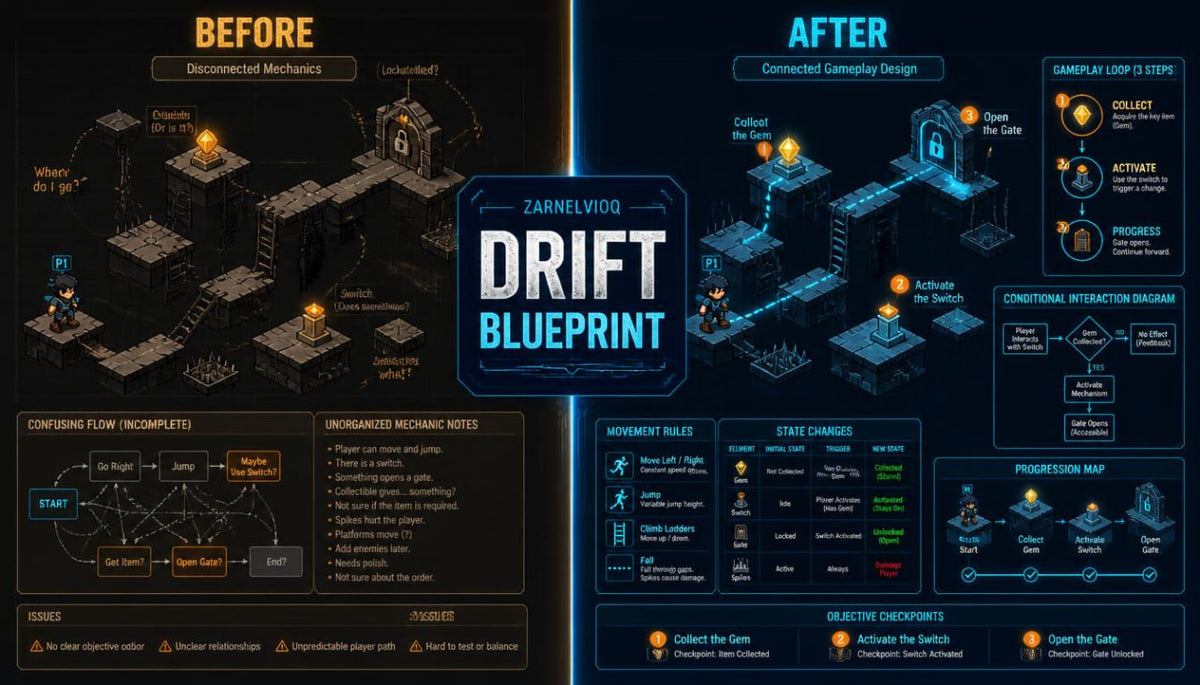
Understanding the basic principles of game development is an important starting point, but turning isolated ideas into a coherent gameplay structure introduces additional challenges. Learners may understand individual mechanics such as movement, object interaction, or scoring without knowing how to connect them within a consistent system. Poorly defined interaction rules can create confusing player experiences, unpredictable responses, and gameplay sequences that lack a clear direction. Without a structured design process, it becomes difficult to evaluate how changes to one mechanic influence other parts of the experience. Developing an organized approach to gameplay planning helps learners examine these relationships and document their creative decisions with greater clarity.
2. Solution
Drift Blueprint introduces a systematic approach to designing gameplay mechanics and organizing interactive experiences. The course examines how player actions, game rules, environmental conditions, and feedback systems influence one another. Learners work through practical examples that demonstrate how individual mechanics can be combined into recognizable gameplay structures. Guided activities introduce methods for documenting interactions, planning progression, and evaluating changes to game behavior. Through structured exercises and design worksheets, participants explore how creative concepts can be developed into detailed gameplay plans.
3. What's Inside
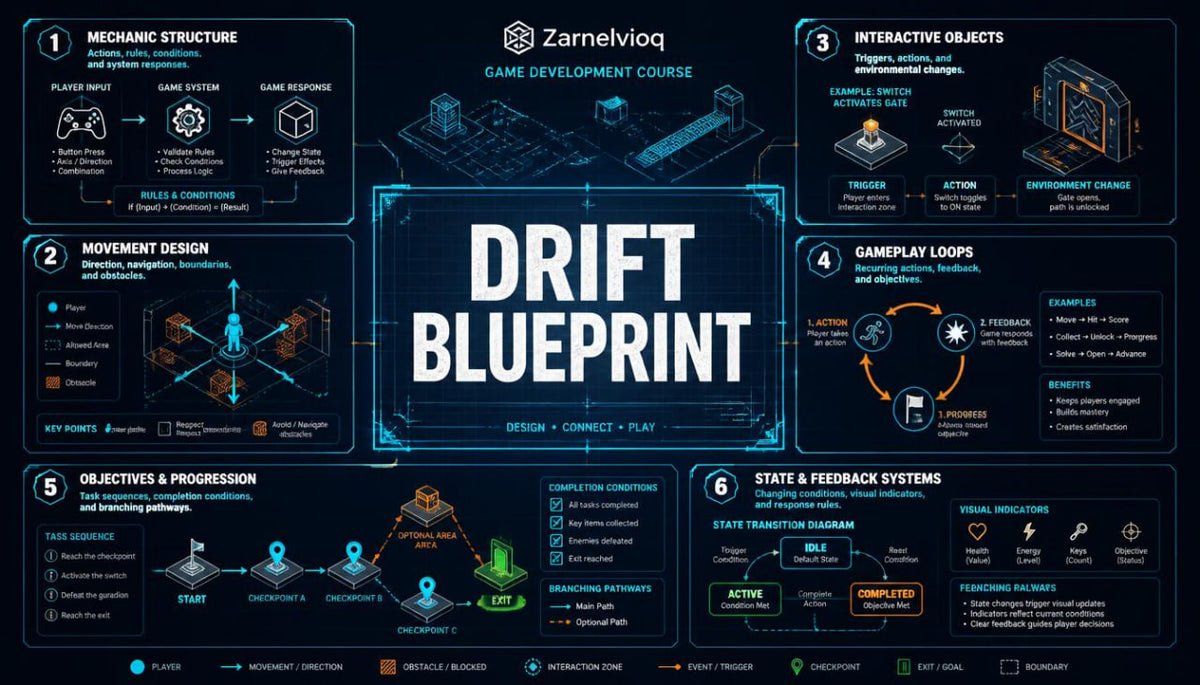
Drift Blueprint contains eight learning modules focused on gameplay structure, interaction planning, and introductory systems design.
The course builds upon foundational game development knowledge and introduces more detailed planning activities that connect individual mechanics into cohesive interactive experiences.
Module 01 — The Structure Beneath Every Interaction
This module examines the underlying relationships that define gameplay systems.
Learners explore the differences between game rules, player actions, interaction conditions, and system responses.
The material introduces methods for identifying which components are responsible for particular behaviors within a game.
Through guided examples, participants examine fictional gameplay scenarios and identify the mechanics operating behind visible interactions.
Practical activity: Create a mechanic inventory for a small game concept, documenting individual actions, conditions, and responses.
Module 02 — Designing Movement With Purpose
Movement is a central component of many interactive environments, influencing navigation, exploration, and player decision-making.
This module examines movement rules, directional control, spatial boundaries, and environmental restrictions.
Learners explore how movement behavior changes when additional conditions are introduced, such as obstacles, movement zones, or alternative navigation paths.
The material also discusses how movement can communicate the characteristics of a game environment.
Practical activity: Develop a movement design sheet containing directional rules, boundary conditions, and three environmental interactions.
Module 03 — When Actions Meet Consequences
Interactive gameplay depends on the relationship between what a player does and how the game responds.
This module introduces structured interaction design through actions, triggers, conditions, and resulting changes.
Learners examine examples involving collectible objects, environmental mechanisms, interaction zones, and changing game states.
Decision diagrams demonstrate how the same player action may produce different responses depending on the current conditions.
Practical activity: Design an interactive mechanism with multiple conditions and document its behavior using an interaction flow diagram.
Module 04 — Building a Meaningful Gameplay Loop
Gameplay loops connect recurring actions with objectives, feedback, and progression.
This module examines how individual interactions can be organized into short recurring sequences.
Learners study how gameplay loops communicate objectives and establish relationships between different activities.
Examples demonstrate how collecting resources, navigating environments, and completing tasks can form connected gameplay patterns.
The module also introduces methods for identifying unnecessary repetition and unclear interaction sequences.
Practical activity: Develop a gameplay loop diagram featuring a central objective, recurring player actions, and defined system responses.
Module 05 — Designing Objectives and Progression
Player objectives provide direction and help organize interactive activities.
This module examines introductory progression structures, task sequences, completion conditions, and changing gameplay requirements.
Learners explore how a series of objectives can introduce new interactions while maintaining consistency with existing mechanics.
The materials compare linear task structures with designs that allow different paths through an experience.
Examples illustrate how progression can be represented through diagrams and written design notes.
Practical activity: Outline a short sequence of gameplay objectives with completion conditions and corresponding environmental changes.
Module 06 — Systems That Respond to Change
Games frequently contain variables that influence how interactive elements behave.
This module introduces basic state-based thinking and its role in gameplay design.
Learners examine how conditions such as object availability, player location, collected items, and completed tasks can influence system responses.
The material explains how different states can be documented and connected through transition diagrams.
Participants also explore the importance of describing invalid or unexpected interactions during the planning process.
Practical activity: Create a state transition map for an interactive object with several possible conditions.
Module 07 — Feedback, Clarity, and Player Understanding
Clear feedback helps players interpret actions and understand changes within an interactive environment.
This module examines visual indicators, environmental reactions, progress markers, and interaction cues.
Learners study how feedback should relate to the action or condition it represents.
Practical examples examine unclear feedback and demonstrate how alternative designs may communicate information more directly.
Participants also consider how excessive visual information can distract from gameplay objectives.
Practical activity: Create a feedback plan for three interactions, explaining what information each response should communicate.
Module 08 — The Blueprint Workshop
The final module brings together the concepts presented throughout Drift Blueprint.
Learners develop a detailed gameplay design document for a small interactive experience.
The project includes a central gameplay concept, movement rules, interaction conditions, progression objectives, and feedback descriptions.
Participants organize their ideas using diagrams, written specifications, and structured planning worksheets.
The concluding activity invites learners to evaluate connections between mechanics and document possible revisions.
Practical activity: Complete a gameplay blueprint that describes a small interactive experience from the initial player action through its central objective.
Additional Course Materials
Drift Blueprint includes supporting resources that correspond to the module activities.
Gameplay Mechanic Inventory: A worksheet for documenting player actions, rules, conditions, and related system responses.
Movement Planning Template: A structured layout for describing navigation behavior, restrictions, and spatial interactions.
Interaction Flow Worksheet: A diagramming resource for mapping actions, triggers, decisions, and outcomes.
Gameplay Loop Planner: A reference sheet for organizing recurring player activities and their relationship to objectives.
Progression Mapping Sheet: A template for documenting task sequences, completion conditions, and changing gameplay states.
State Transition Diagram: A planning resource for illustrating how interactive elements move between defined conditions.
Feedback Design Checklist: A review resource for examining whether important gameplay information is communicated clearly.
Gameplay Blueprint Workbook: A structured collection of planning pages used during the concluding design activity.
These materials support independent practice and can be revisited when exploring additional gameplay concepts.
4. Who Is This For?
Drift Blueprint is intended for learners who understand introductory game development concepts and want to explore gameplay systems in greater detail.
The course may be suitable for individuals interested in interactive design, gameplay mechanics, level planning, and the relationship between player behavior and game rules.
It is particularly relevant to learners who enjoy analyzing how games respond to actions and how individual mechanics contribute to a wider interactive structure.
Participants who have completed an introductory game development course may find the activities a natural continuation of their studies.
The course also welcomes independent learners who have already explored basic gameplay terminology through personal study.
Previous programming experience is not required for the planning exercises, although familiarity with basic game design concepts is helpful.
The materials concentrate on conceptual design, structured documentation, and systems thinking rather than requiring the creation of a completed digital game.
5. What You'll Learn
Drift Blueprint examines the following practical skills and areas of knowledge:
-
Identify relationships between gameplay mechanics, rules, and player actions.
-
Create structured descriptions of interactive systems.
-
Document movement behavior and environmental restrictions.
-
Design interactions using triggers, conditions, and responses.
-
Develop gameplay loops around defined objectives.
-
Map progression sequences and completion requirements.
-
Describe changing game states and their transitions.
-
Analyze how individual mechanics influence wider gameplay structures.
-
Create decision diagrams for interactive objects.
-
Develop feedback plans that communicate gameplay information.
-
Recognize inconsistencies within interaction rules.
-
Organize multiple gameplay elements into a design document.
-
Apply structured observation techniques to fictional gameplay scenarios.
-
Evaluate and revise gameplay concepts through written design exercises.
-
Prepare a gameplay blueprint containing connected mechanics and objectives.
The course focuses on building practical design knowledge through explanation, planning, and independent experimentation.
6. 30-Day Refund Information
A Clear Approach to Course Purchases
Drift Blueprint is a digital educational course containing structured learning modules, planning exercises, and supporting materials.
Refund requests may be submitted within 30 days of purchase, in accordance with the Zarnelvioq Refund Policy and applicable consumer protection requirements.
Before purchasing, learners are encouraged to review the course description, included materials, delivery details, and published refund conditions.
- 📦 Digital file available after purchase
- 🔄 Long-term availability
- 🛡️ Secure checkout
- 🔄 Content updated in 2026
Self-paced learning overview
What topics are covered in Zarnelvioq courses?
What topics are covered in Zarnelvioq courses?
Zarnelvioq courses explore different areas of game development, including gameplay mechanics, interactive environments, design structures, player interaction, and project planning. Each course focuses on a defined set of topics, combining theoretical explanations with practical activities that encourage learners to examine how interactive experiences are created.
Do I need previous game development experience?
Do I need previous game development experience?
The recommended background depends on the selected course. Introductory materials explain foundational concepts, while later courses examine more detailed design processes and technical structures. Each course description outlines its learning focus so participants can select materials that correspond to their current knowledge.
How are the learning materials organized?
How are the learning materials organized?
The courses are arranged into topic-based modules with explanations, examples, and practical exercises. The learning sequence moves from individual concepts toward activities that connect related ideas. Participants can review the materials at their own pace and revisit individual sections while developing their understanding.
Share